Digital Calendars vs Smart Displays (Echo Show, Nest Hub)
Compare Digital Calendars vs Smart Displays like Echo Show and Nest Hub. Learn differences in usability, features, and which is better for daily planning.
When I needed a more convenient control of day-to-day schedules at home, I began to compare digital calendars with smart displays. I was already using a digital calendar to plan, but it did not escape my attention that it could be interesting to have smart displays such as the Echo Show and Nest Hub. They offered voice recognition, display of information and smart home. I wondered whether they were able to substitute a committed digital calendar. The thought of not needing to go out anytime to get anything was alluring. But features are not as important as practicality. I would like to know the difference between these options in the real life.
Having applied both methods, I understood they are used to different purposes. Digital calendars emphasize solely on visibility and planning. Intelligent screens attempt to accomplish a lot simultaneously. The difference influences their effectiveness in the aspects of organization. The knowledge of these differences thus allowed me to choose which one is more compatible with my lifestyle. It is not which one is more advanced which is to be compared. It is regarding what one advocates planning more credibly.
Amazon Affiliate Disclaimer
https://digicalendars.com participates in the Amazon Services LLC Associates Program, an affiliate advertising program designed to provide a means for websites to earn fees by linking to Amazon.com and other affiliated sites. As an Amazon Associate, we earn from qualifying purchases made through the links on our website. This does not affect the price you pay your support simply helps us maintain the site and continue offering honest, valuable reviews and recommendations.
Purpose and Core Function
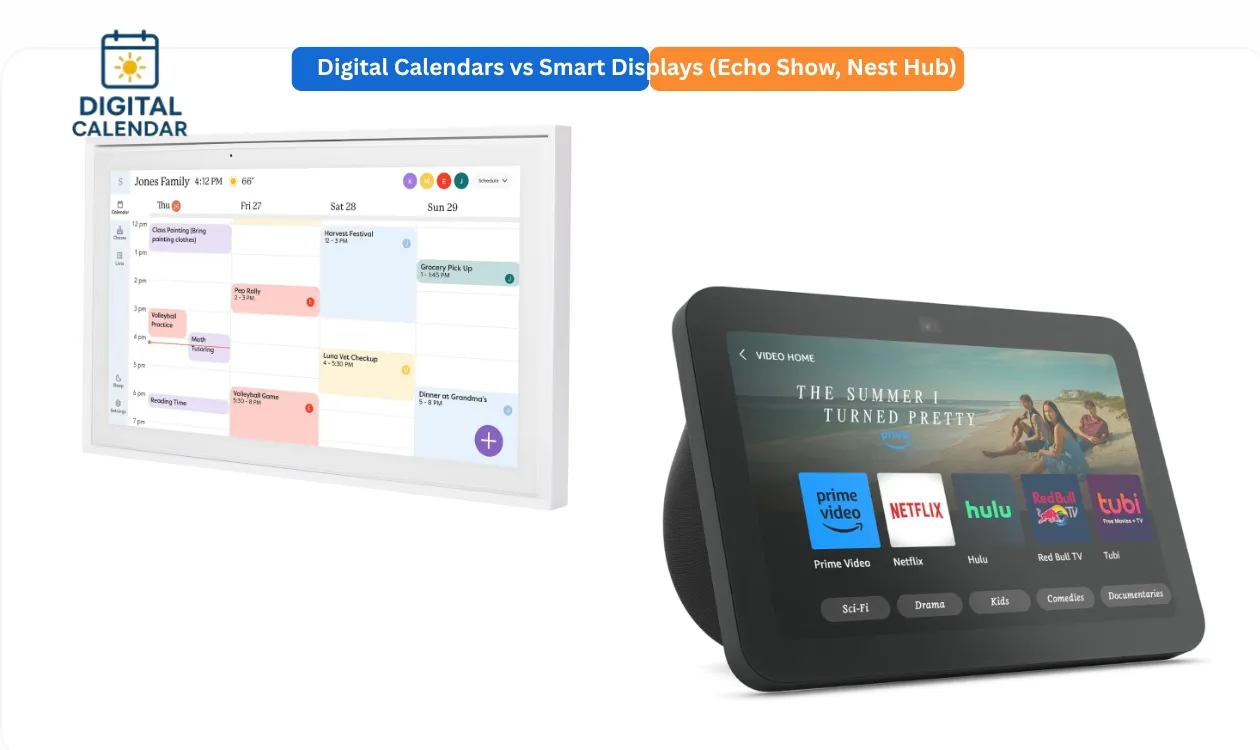
A digital calendar is constructed towards a single objective, which is scheduling and planning. All the information on the screen promotes that purpose. I do not get distracted by schedules, routines, chores, and reminders. The display stays focused. This transparency enhances day to day organization. I do not have to browse through menus. Planning still takes the centre stage.
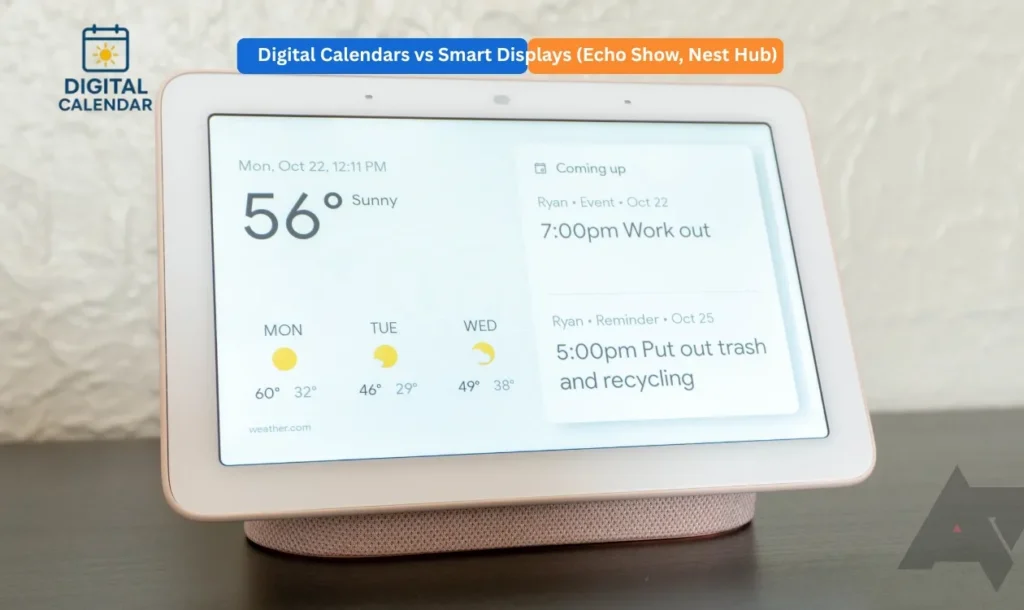
Smart displays, in their turn, are used in several purposes. They display calendars, though also videos, music, weather, and control of a smart home through a central interface. This versatility is impressive. Planning is however not the only feature. The calendar tends to be marginal. Such variance influences the frequency with which I rely on it to make schedules.
Best Digital Calendars
Visibility and Always-On Display
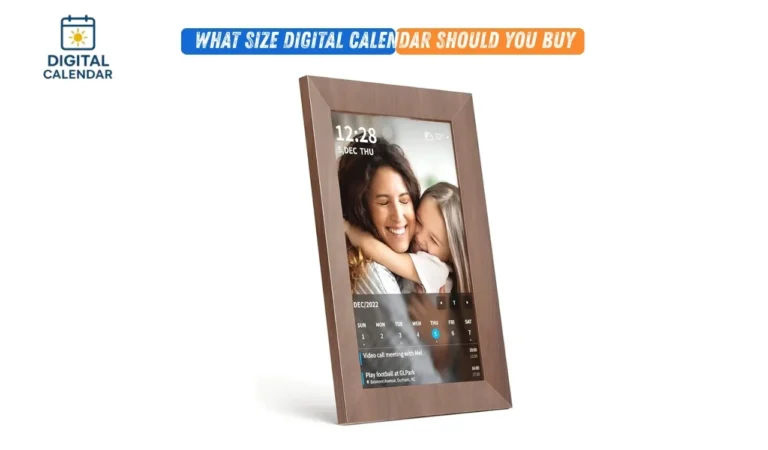
One of the greatest benefits of the digital calendars is their visibility. The timetable is made continuously. I can glance at it anytime. This publicity of plans keeps them at the forefront of mind. It embraces passive planning. I do not need to ask or tap. The calendar simply exists.
Smart displays do not necessarily revolve around the calendar view. The screen is frequently changing. It displays photos or recommendations sometimes. Other times it goes idle. I need to ask or tap to view the schedule frequently. That additional measure lowers the effectiveness in planning.
How to Use Digital Calendar’s Features – Complete Guide
How to Use Digital Calendar’s Features 2 – Complete Guide
Focus vs Distraction
Digital calendar provides a non-distracting atmosphere. No irrelevant notifications related to planning. I feel calm when looking at it. I focus on my timetables and habits. Such concentration eliminates mental distractions. It supports consistency.
Smart displays will be interactive. Advertisements, recommendations, and information are regular through constant notifications. Although it is helpful, it may distract planning. I occasionally lose attention with other contents as they come up. To stay focused, the limited number of distractions suits me better.
Best Digital Picture Frames
Interaction Style
Digital calendars are based on touch and visuality. I update them intentionally. This makes the planning deliberate. It is me who determines what is on the screen. Communication is hierarchical and orderly.
Voice commands are imperative to smart displays. Voice recognition is also convenient, particularly, hands-free. Nevertheless, it cannot be accurate at all times. I sometimes repeat commands. Touch-based interaction is more trustworthy as far as the detailed planning is concerned. It is the difference which influences everyday comfort.
Digital Calendars
Family and Shared Use
Digital calendars are created to be shared. All people are exposed to the same information. Members of the family do not require personalized devices. Such a common sight enhances communication. A sense of responsibility is present.
Smart displays are also shareable, however, in many cases, they are based on personal voice profiles. This can create confusion. All people do not communicate in a similar manner. An electronic calendar is more inclusive and neutral. That is important on common grounds.
Strengths of Smart Displays
Calendars are not the only benefits of smart displays. They are compatible with intelligent houses through smart integration. They provide entertainment and news. To certain families, this utility is important.
Smart displays are strong at:
- Voice-controlled interaction
- Smart home integration
- Multimedia content
- Quick information access
- Hands-free assistance
These strengths make them great all-in-one devices. However, they are not focused planners. Their value depends on priorities.
Reliability for Daily Planning
Planning tools are concerned with reliability. Electronic planners are uniform. They demonstrate timetables transparently on the daily basis. I do not spend much time concerned with my calendar view. It is always there.
Intelligent displays rely on software conditions and requirements. Not all the time the calendar is on the first sight. This discrepancy has an impact on trust. Predictability is important in terms of planning. Indeed, online calendars are more reliable.
Learning Curve and Ease of Use
Online calendars are not complicated. It adapts fast even among non-technical users. The interface is simple with an intuitive layout. No commands are required. This is an ease of use that promotes longevity.
Smart displays involve the training of voice commands and settings. Some users enjoy this. Others find it frustrating. The comfort with technology determines ease of use. To make it simple, digital calendars are the best to me.
Which One Fits Different Lifestyles
Of great importance in the decision between these choices is lifestyle. Digital calendars are more appropriate in case planning and organization are the primary objectives. They subscribe to practices silently. They stay focused.
Smart displays are bright in case entertainment and smart home control are more important. They are diverse and convenient. This will be determined by priorities. This knowledge assisted in making the right choice.
How I Decided What Works Best for Me
I understood that I needed an application that helped me to plan and not do it distractedly. Online planners fulfilled that requirement. Smart displays were strong but ineffective in terms of scheduling. I did not like features as much as I liked clarity.
It does not imply that intelligent displays are poor. They just play an alternate purpose. Digital calendars were more appropriate to my requirements. This was not a choice that was made by specifications, but by daily experience.
FAQs: Digital Calendars vs Smart Displays
Conclusion
In my case, digital calendars and intelligent displays are used with a different purpose. Digital calendar is perfect in focus, visibility and regular planning. Smart displays are time-saving and multi-purpose but distractive. They are not objectively superior because they suit various needs.
A digital calendar will be more appropriate in case you want to have clear and reliable scheduling. Smart displays are logical in case you desire a smart device at once. It is important to know how all of them can be applied to everyday life. In my case, concentrated planning was better than multifunctionality.
Fore more information about Digital Calendars and Picture Frames ,then hit the button.